

Since its birth in the late 90s, the wood composite market has experienced spectacular growth. The industry, which originated in North America, is now dominated by leading companies with sales in excess of one billion dollars.
Although the market has slowed down over the past two years, it is still expanding at a remarkable average rate of 5-7%.
According to Principia DemandBuilder® , Wood Composite decking in the USA accounts for almost 25% of the market, valued at $4 billion, and forecasts suggest that this share could rise to 50% in the long term.
In France, according to a study carried out by LCB in 2021, the market is estimated at 3 million m², representing just under 20% of the total market. In Europe, Germany is the leading market for wood composites, although first-generation monoextruded woods still dominate.
It's also worth noting that the composite cladding market is beginning to develop in Europe, and promises to take a significant place over wood.
Growth drivers
1 – Technological advances
One of the key drivers of this growth is constant innovation in technology and design. Technological advances have enabled the development of wood composite decking that offers enhanced durability, total resistance to rot and insects, and low maintenance.
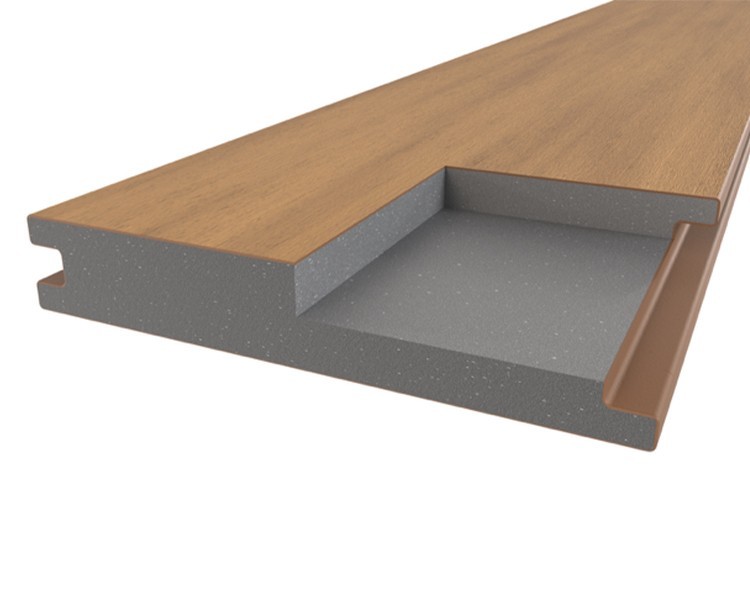
Co-extrusion technology, developed in the late 2000s, protects composite wood with a thin polymer coating. These improvements make composite decking particularly durable, stain- and fade-resistant for consumers seeking solutions that are both aesthetically pleasing and practical.
2 – Innovative design

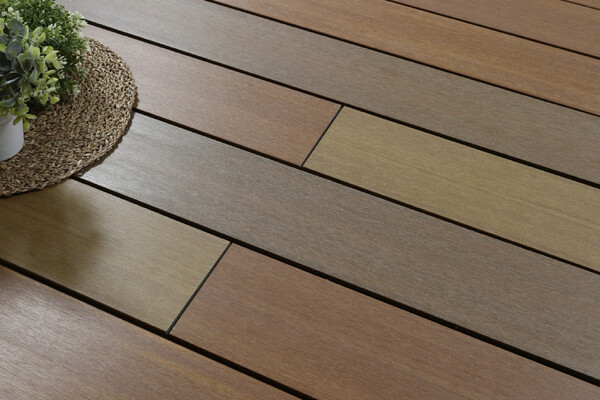
The latest deck boards are visually stunning. Whether you opt for a sleek, modern style or a rustic, wood-like finish, there's a choice of composite decking materials. It's fascinating to observe how the market is constantly pushing the boundaries.
Decors and colors are becoming increasingly impressive, imitating the uniqueness of wood. Wood grain and veining are reproduced with striking realism.
2 – High durability
Co-extruded wood composite stands out for its exceptional durability, making it the material of choice for exterior landscaping projects. Thanks to its advanced design, which incorporates an external protective layer. This protective layer is designed to resist UV rays and humidity, preserving the material's appearance and properties over time.
What's more, co-extruded wood composite offers outstanding resistance to biological attack, such as insects and wood-destroying fungi, which can seriously damage natural wood. Thanks to its unique composition, combining wood fibers and polymers, it creates an effective barrier against these threats. This robustness against biological aggression gives wood composite a lifespan of at least 50 years.
3 – Low maintenance
The longevity and low-maintenance properties of co-extruded wood composite are key features that appeal to homeowners and builders alike. Unlike natural wood, which requires regular treatment with preservatives and colorants, composite wood requires very little care. This lack of need for periodic treatment represents a significant long-term economic advantage, reducing maintenance costs and effort.
Co-extruded wood composite decking retains its original color, avoiding the disadvantages associated with saturators used on natural wood, which oxidize and darken the color over time.
4 – Environmental responsibility
Growing environmental awareness also plays a crucial role. Co-extruded composite materials are made from recycled plastics and waste wood fibers, reducing dependence on virgin natural resources and lowering consumers' carbon footprint. This feature is particularly attractive to environmentally conscious customers.
Restrictive factors
1 – High initial cost
However, the initial cost of wood composite decking can be an obstacle. Although these decks offer long-term economic benefits, the initial investment is 2 to 3 times higher than that treated pine or traditional hardwood deck, which still represents 60% of the market, and this may discourage some potential buyers.
2 – Limited color and style options
In addition, although the industry has made progress in terms of color and texture variety, options remain relatively limited compared to those available for natural wood. This lack of diversity can be a deterrent for some consumers seeking precise aesthetic specifications for their outdoor space.
Conclusion
The wood composite industry is at a crossroads, where technological innovation and environmental responsibility meet to offer sustainable, aesthetically pleasing solutions for exterior landscaping. Although faced with challenges such as high initial cost and decors that are still limited compared to natural wood, the sector continues to push the boundaries, promising an even brighter future for this booming market.
However, exotic wood should not be contrasted with composite wood. Contrary to popular belief, composite wood does not save tropical forests. In fact, FSC-certified exotic wood protects forests, paradoxical as this may seem (see previous article). This duality underlines the importance of choosing materials wisely and responsibly, taking into account their overall environmental impact.
+ More information on fiberdeck.com wood composites